
Fix these four things before you opt for foundation repair
Updated: May 15
If you live in an area with expansive soils like in the Brazos Valley, you will probably notice some symptoms of seasonal movements in your building. These symptoms can include anything from cracks in your finishes, to uneven floors and sticky doors.
Sometimes, the foundation movement is minimal and manageable. Sometimes you might need a structural assessment and a repair plan.
But there is an in-between stage where you notice a problem, but it might not be dire enough to call for a full-blown foundation repair plan. What are some things you can do to mitigate foundation movement before you actually commit to foundation repair?
The Name of the Game
Expansive soils swell in the presence of water, and shrink when the water leaves. This phenomenon causes the foundation movement. The name of the game is to control the water flow around the foundation. The goal is to make sure water does not have time to sit within or directly next to the building, which can cause swelling of expansive soils and many foundation distress symptoms.
Plumbing
Plumbing leaks are typically the cause of the most dire foundation movement issues in expansive soils. If a plumbing leak is discovered, it must be fixed immediately. You must watch your water bills like a hawk and note any spikes in the pricing.
Regularly walk around your building to make sure there are no permanent wet spots. If you notice a wet spot around your foundation, especially around where you know a pipe should be, call a plumber immediately.
Gutters
A functioning gutter system can mitigate a lot of foundation distress symptoms.
Make sure your gutters are clean and clear
A clogged gutter (especially on a lot with a multitude of pine trees) can render your gutter system useless for managing the water runoff from your roof. If your gutters are clogged, runoff from rain will spill over and end up right at the perimeter of your building. The excess water will cause swelling in the soils around the foundation, and can manifest in phenomenon like cracks in the building facade. If your building is on a lot with mature trees, we recommend gutter cleaning once a year before the rainy season.
Make sure your downspouts are connected to your gutter system
Making sure you understand how your gutters work and where the downspouts discharge to are very important steps in trying to reduce foundation movements.
Your downspouts have to be connected to the gutter system. If there is a disconnect between the downspout and the gutter, the water from your gutters will cascade down the side of your wall and pool around the perimeter of your foundation.
Not only can a disconnected gutter downspout cause foundation distress symptoms, it can also discolor the facade of the building. Further, the constant water runoff can lead to rot and mold in your structure if your building is wood-framed. If your building is steel-framed, the constant water runoff can lead to rust in your structural members.

Get the water far away
The gutter downspout must discharge far away from the foundation. Cutting the downspout right at the foundation will actually increase the chances that you may develop foundation problems at the perimeter of your building.
The International Residential Code (which has been adopted widely as law in most municipalities in the US) actually states in section R801.3 that the gutters must discharge a minimum of five (5) feet away from the building. This is the rule of thumb for most buildings, not only residences. This rule inherently requires site planning for the gutter system, which most people do not know they need to do for their building.
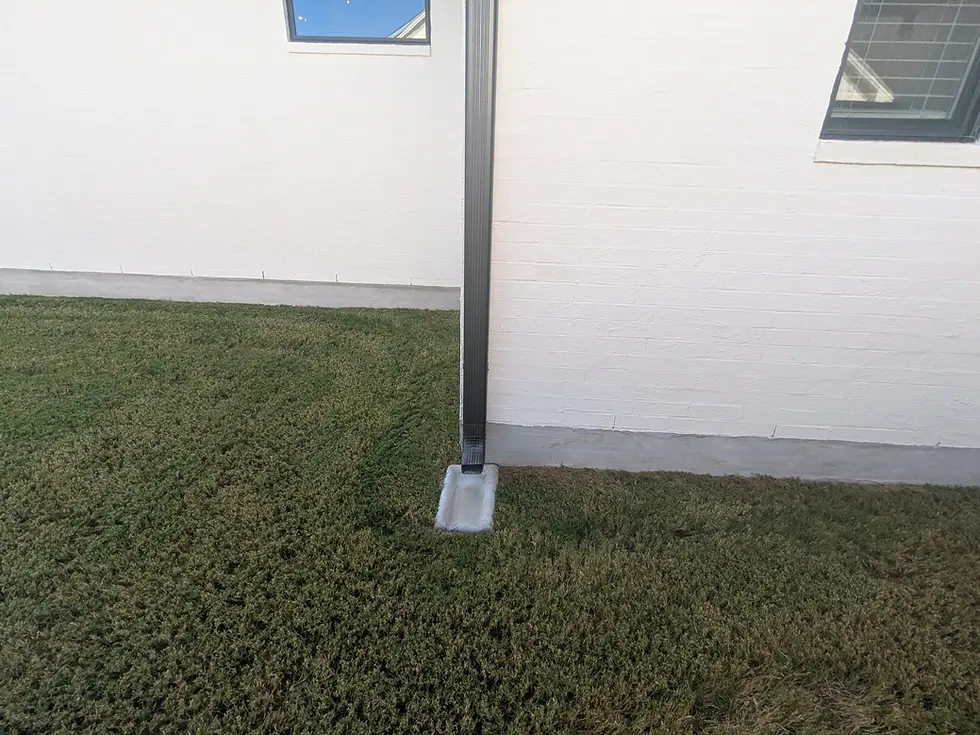
In our experience, it may be impractical to go the full five feet on an existing building with a not-so-great site plan. Our recommendation is a minimum of three (3) feet for retrofit solutions.
For new builds on highly expansive soils, we recommend five (5) feet, with gutter planning and design to manage runoff.
Trees
Tree roots can cause both heave and settlement in shallow foundations on expansive soils. Trees typically travel horizontally in a wide circle to find water. If a tree with a wide root base is planted very close to the foundation, the roots can interfere in the moisture management around the foundation.

If there is a moisture source near the foundation, the tree root will travel towards the source. The tree root can push up the soil in its search for water, and can cause heaving in the foundation beam and significant symptoms of foundation distress.
If the tree root is deep enough to get under the foundation beam without affecting the foundation, the root can take out enough moisture under the foundation to cause shrinkage in the soil.
If you are thinking about planting a tree near your building, find out the maximum root base diameter of the tree species you are considering, and plan to plant the tree at that distance away from your building with a 1.5 safety factor.
If you have an existing tree close to the foundation, it might be ill-advised to remove the tree. If the tree is removed, a void can form anywhere along the root as the roots of the tree decay. Further, the moisture that was being removed by the roots will now stick around, and in some cases, will cause heave after the removal.
Existing tree roots can be stopped from interfering with the foundation by installing a tree root barrier around the foundation perimeter of your building.
Fountains
Under no circumstances should you consider putting a fountain within 20 feet of your building if you have a slab-on-grade on expansive soils.
If you insist on a fountain close to your building and it is a new build, we recommend a deep foundation system with piers.
Need help on a project? Call 713-909-0458 or email info@o3structural.com


Comments